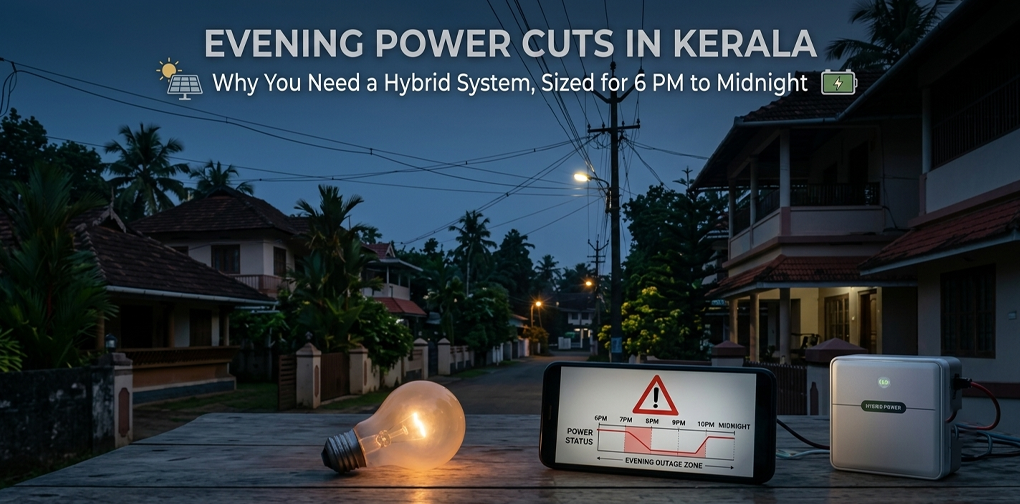
If you live in Kerala, you may have noticed the pattern. The lights flicker, the fan slows, the Wi-Fi drops, and it's always in the evening, just when the family is home, children are studying and dinner is being cooked.
This year, evening power cuts Kerala homeowners face have become a regular part of life for many households. KSEB has imposed peak-hour load restrictions between 6 pm and midnight, and recent reports put the evening supply gap at several hundred megawatts. Officials have said the restrictions are needed to protect the grid when demand is at its highest.
For homeowners, the practical question is simple: how do you keep your home running when the grid can't? For many families, the answer is a hybrid solar system Kerala homes can rely on, sized for the 6 pm to midnight window rather than for an average hour of the day.
Why evening power cuts in Kerala happen after sunset
Kerala's electricity demand peaks after sunset. As people return home, lights, fans, air conditioners, televisions, water pumps and kitchen appliances all come on together. KSEB has repeatedly asked consumers to reduce heavy usage between 6 pm and 11 pm, and the high-demand period has stretched later into the night in recent months.
Two things make evening power cuts Kerala households face so difficult to manage:
- The cuts are often unannounced. The regulator has pushed KSEB to move towards pre-declared time slots, but in practice, outages can come at any point in the evening.
- The cuts can be repeated. A home may face several short interruptions across the evening, not just one.
This is the opposite of when your solar panels generate power. Panels produce most of their energy from morning to mid-afternoon and nothing after dark. So the evening problem is really a storage problem.
Why a standard on-grid solar system in Kerala doesn't help
Most rooftop systems in Kerala are on-grid. They are affordable and reduce your KSEB bill, but they have a safety feature called anti-islanding: when the grid goes down, the inverter shuts off too. That protects line workers, but it also means your panels can't power your home during a power cut, even on a sunny day.
And even if they could, the evening cut happens after the sun is gone.
What a hybrid solar system with battery backup does
A hybrid solar system for home use combines solar panels, a hybrid inverter, a battery bank and a grid connection. In simple terms:
- During the day, your panels power your home, charge the battery and, where net metering applies, send surplus power to the grid.
- When the grid fails, the hybrid inverter switches to battery power within moments, so essential loads keep running.
- In the evening, stored solar energy reduces how much you draw from the grid at peak time.
In other words, you generate during the day, store the energy and use it when the grid is under the most stress.
Why size your solar battery backup for 6 PM to midnight
Many solar battery backup Kerala systems are sized by guesswork: "a 5 kVA inverter and a few batteries should be fine." That often leads to one of two problems. Either the battery drains in an hour because the load is bigger than expected, or you pay for capacity you never use.
A better approach is to design around the actual window that matters. Evening cuts are usually short, but they can repeat and are hard to predict. Sizing for the full six hours from 6 pm to midnight gives you a margin for multiple interruptions, and for days when cuts run longer than usual.
How to size a hybrid solar system in five steps
Step 1: List the loads you want to keep running. Decide what is essential. Most families choose lights, fans, the refrigerator, TV, Wi-Fi router and phone and laptop charging. Some add a water pump, a mixer-grinder or one air conditioner.
Step 2: Estimate the energy for the 6-hour window. Multiply each appliance's power (in watts) by the hours it runs, then add everything up. Here is an illustrative example for an average home:
| Appliance | Power | Hours (6 pm to midnight) | Energy |
|---|---|---|---|
| 8 LED lights | 10 W each | 5 | 0.4 kWh |
| 4 ceiling fans | 70 W each | 6 | 1.7 kWh |
| Refrigerator | about 60 W average | 6 | 0.4 kWh |
| TV | 100 W | 3 | 0.3 kWh |
| Wi-Fi, chargers, laptop | 60 W | 6 | 0.4 kWh |
| Essential load total | about 3.2 kWh | ||
| 1.5-ton inverter AC (optional) | about 1,000 W average | 4 | 4.0 kWh |
| Total with one AC | about 7.2 kWh |
These are typical figures for illustration only. Your actual numbers depend on your appliances, so use your own list.
Step 3: Work out the battery capacity. You can't use all of a battery's rated capacity, and some energy is lost in conversion. Lithium iron phosphate (LiFePO4) batteries typically allow a high depth of discharge, so as a rough guide, about 4 kWh of lithium battery covers the essential load above, and about 9 to 10 kWh covers the load with one AC. Lead-acid batteries allow only around half their capacity to be used, so you would need roughly twice the rated capacity for the same backup.
Step 4: Choose the inverter capacity. The inverter must handle your peak simultaneous load, not just the total energy. A home running essentials only might need around 1 to 2 kW, while a home that wants an AC and a pump to run together typically needs 3 kW or more. Motors such as pumps and compressors draw a surge when they start, so ask your installer to account for it.
Step 5: Size the solar array to refill the battery. Your panels need to cover your daytime use and fully recharge the battery. For the 3 kW class home above, that usually means a solar capacity of around 3 to 5 kW, depending on your roof, shade and daily consumption. A site survey will confirm this.
Lithium or lead-acid: which solar battery is better?
Lithium (LiFePO4) costs more upfront but is lighter, has a longer cycle life, allows deeper discharge and needs little maintenance. For daily cycling, it usually works out better over time.
Lead-acid (tubular) costs less upfront but is bulky, needs topping up in some types and has a shorter life when cycled deeply every day.
For a home that expects regular evening use, we usually recommend lithium. For a budget-limited home that only needs occasional backup, tubular batteries can still make sense.
Practical tips to stretch your solar battery backup
- Keep heavy loads off the backup circuit. Water heaters, induction cooktops, irons and washing machines drain batteries quickly. KSEB itself has asked consumers to avoid these in the 6 pm to 11 pm window.
- Use efficient appliances. BLDC fans, LED lights and inverter ACs use far less energy than older models.
- Create a separate "essential loads" panel. Your installer can wire only the circuits you want backed up.
- Check your battery's state regularly. Many hybrid systems let you monitor charge and usage on a phone app.
Common hybrid solar mistakes to avoid
- Buying a battery without listing your loads first
- Choosing an inverter that is too small for pump or AC starting loads
- Connecting the whole house to the backup instead of essential circuits
- Assuming solar alone will run the house during every outage
- Hiring an installer with no local service support
Get your hybrid solar system sized properly
The right hybrid solar system for home use is not the biggest one. It's the one built around your own evening load. Illumine Energy has completed 5,000+ projects and over 10 MW of solar capacity across Kerala, and offers on-grid, hybrid and off-grid systems with engineering support, installation and AMC.