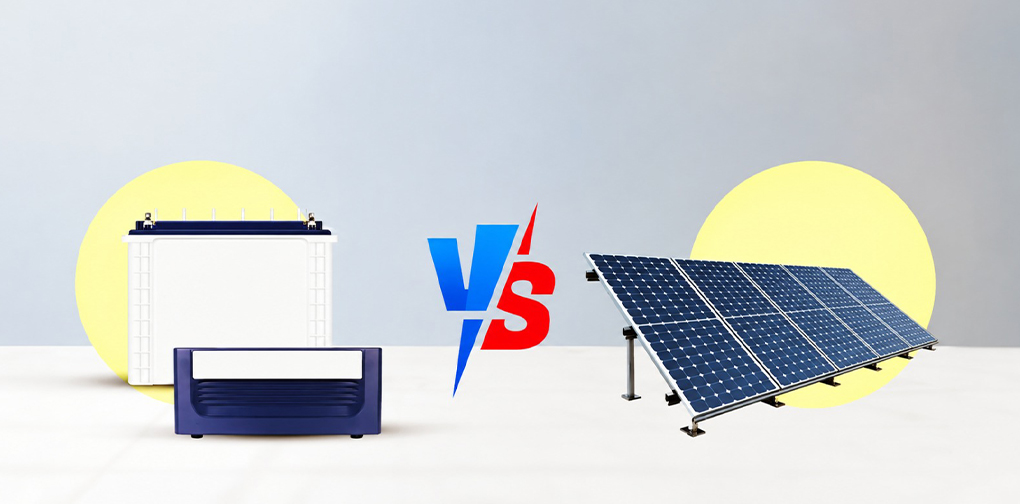
Solar Panel vs Solar Battery: What Should You Invest in First?
If you are planning to switch to solar energy, you may have an important question: Should you invest in solar panels first, or should you choose a solar battery?
The answer depends on what you want from your solar system.
Solar panels and solar batteries serve two different purposes. Solar panels generate electricity from sunlight, while solar batteries store electricity for later use. If your primary goal is to reduce your electricity bill, solar panels may be your first priority. If your main concern is power backup during outages, battery storage becomes much more important.
For homeowners in Kerala, this decision is becoming increasingly relevant as rooftop solar adoption grows and more households consider solar-plus-storage and hybrid systems.
In this guide, we will compare solar panels vs solar batteries, explain how each works, and help you understand which option may be suitable for your home.
What Is a Solar Panel?
A solar panel converts sunlight into electricity through photovoltaic technology.
During daylight hours, solar panels generate DC electricity. An inverter then converts this electricity into AC power that can be used by household appliances.
A rooftop solar system can help homeowners reduce their dependence on grid electricity and lower their electricity bills.
For example, a home may use solar energy during the daytime for appliances such as:
- Fans
- Refrigerators
- Washing machines
- Water pumps
- Televisions
- Computers
- Air conditioners
The amount of electricity generated depends on factors such as system capacity, sunlight availability, roof orientation, shading and weather conditions.
What Is a Solar Battery?
A solar battery stores electricity so that it can be used later.
Solar panels generally produce electricity during the day, while many households continue to consume electricity during the evening and night. A battery can store surplus solar energy generated during the day and make it available when required.
Battery storage can also provide backup power when the electricity grid is unavailable, depending on the system configuration.
This makes batteries particularly useful for homeowners who want both solar energy and backup power.
Solar Panel vs Solar Battery: What's the Difference?
The simplest way to understand the difference is:
| Feature | Solar Panel | Solar Battery |
|---|---|---|
| Main purpose | Generates electricity | Stores electricity |
| Works primarily | During sunlight hours | When stored energy is needed |
| Reduces electricity bills | Yes | Indirectly |
| Provides backup | Not by itself | Yes, when integrated with a suitable system |
| Stores energy | No | Yes |
| Useful for power cuts | Limited on its own | Yes |
| Part of hybrid system | Yes | Yes |
So, solar panels and solar batteries are not really competing technologies. They work together in many modern solar systems.
Should You Invest in Solar Panels First?
For many homeowners, solar panels are the starting point.
If your main objective is to reduce your electricity bill, an on-grid solar system may be a suitable option.
An on-grid solar system is connected to the electricity grid and normally does not require battery storage. Electricity generated by the solar panels can be used by the property, while surplus generation can be exported to the grid according to the applicable grid arrangement.
This can make on-grid solar attractive for homeowners who:
- Want to reduce electricity costs
- Have a reliable grid connection
- Use a significant amount of electricity during the daytime
- Do not require battery backup
- Want a simpler solar installation
However, there is an important limitation.
Solar panels alone do not automatically provide backup during a power cut.
A conventional grid-connected solar system is designed to shut down when the grid goes down for safety reasons. Therefore, simply having rooftop solar does not mean your home will continue receiving solar electricity during a blackout.
If backup is important to you, you may need a battery-based or hybrid system.
When Should You Invest in a Solar Battery?
A solar battery becomes more valuable when energy storage and backup power are important priorities.
You may want to consider battery storage if:
- Your home experiences frequent power interruptions
- You want backup electricity at night
- You use important appliances during power cuts
- You want to store excess solar energy
- You want greater energy independence
- Your electricity consumption is higher during evenings
For Kerala homeowners, this is becoming an increasingly relevant consideration. Recent reporting indicates growing interest in solar-plus-storage systems in the state, with consumers exploring batteries alongside rooftop solar to address backup requirements.
What About a Hybrid Solar System?
If you want the benefits of both solar panels and battery storage, a hybrid solar system may be the better solution.
A hybrid solar system combines grid-connected solar with battery storage.
During the day, solar energy can power the home's appliances. Excess energy can be used to charge the battery. Depending on the system configuration, surplus energy may also be exported to the grid.
When solar generation is unavailable or the grid fails, stored battery energy can be used to supply selected loads.
Illumine Energy describes hybrid systems as a combination of on-grid and off-grid functionality, allowing the system to intelligently manage solar power, battery storage and grid electricity.
How Does a Hybrid Solar System Work?
A typical system works approximately like this:
Sunlight → Solar Panels → Hybrid Inverter → Home Appliances
At the same time:
Excess Solar Energy → Battery Storage → Evening/Backup Power
And when required:
Grid → Home / Battery
This provides greater flexibility than a basic grid-connected solar system.
Solar Panel or Battery: Which Is Better for Kerala Homes?
There is no single answer for every household.
The right choice depends on your electricity usage, budget, backup requirements and the way you use electricity.
Choose solar panels first if:
Your main goal is reducing your electricity bill.
An on-grid system may be appropriate if you have a reliable grid connection and do not require backup during outages.
Consider battery storage if:
Your main concern is power cuts and backup.
A battery can store energy and provide electricity when solar generation is unavailable or when the grid goes down, provided the overall system is designed for backup operation.
Consider a hybrid system if:
You want both electricity-bill savings and backup power.
A hybrid system can combine solar generation, battery storage and grid electricity, making it a flexible option for modern homes.
Why Battery Storage Is Becoming More Relevant in Kerala
One of the challenges with rooftop solar is that electricity generation and electricity consumption do not always occur at the same time.
Solar generation is strongest during daylight hours. However, household demand can remain high during the evening and night.
Kerala's electricity-demand pattern has also highlighted the importance of matching solar generation with periods of demand. Recent analysis has pointed to storage as one way of making better use of distributed solar generation.
This is where batteries can play an important role.
Instead of using all the solar electricity immediately, a suitable battery system can store some of the generated energy and make it available later.
What About Solar Batteries During Power Cuts?
This is one of the biggest differences between an ordinary on-grid solar system and a battery-backed system.
During a grid outage, a standard grid-tied solar system generally shuts down for safety reasons.
A suitable hybrid or off-grid solar system, however, can provide backup through stored battery energy.
Illumine Energy's off-grid solar systems are designed around battery storage for backup and electricity-bill reduction, while its hybrid systems combine grid connectivity with battery-based backup.
The actual appliances that can operate during an outage depend on:
- Battery capacity
- Inverter capacity
- Solar system size
- Appliance load
- Backup duration
- System configuration
Choose the Right Solar Solution with Illumine Energy
Illumine Energy provides on-grid, off-grid and hybrid solar installations in Kerala, with solutions designed for residential and commercial requirements.
Whether you are looking to reduce your KSEB electricity bill, prepare for power cuts, add battery storage or move towards greater energy independence, the right solar configuration can make a significant difference.
Ready to find out whether solar panels, battery storage or a hybrid system is right for your home?
Contact Illumine Energy for a customised solar assessment and choose a solar solution based on your electricity consumption, backup requirements and future energy needs.